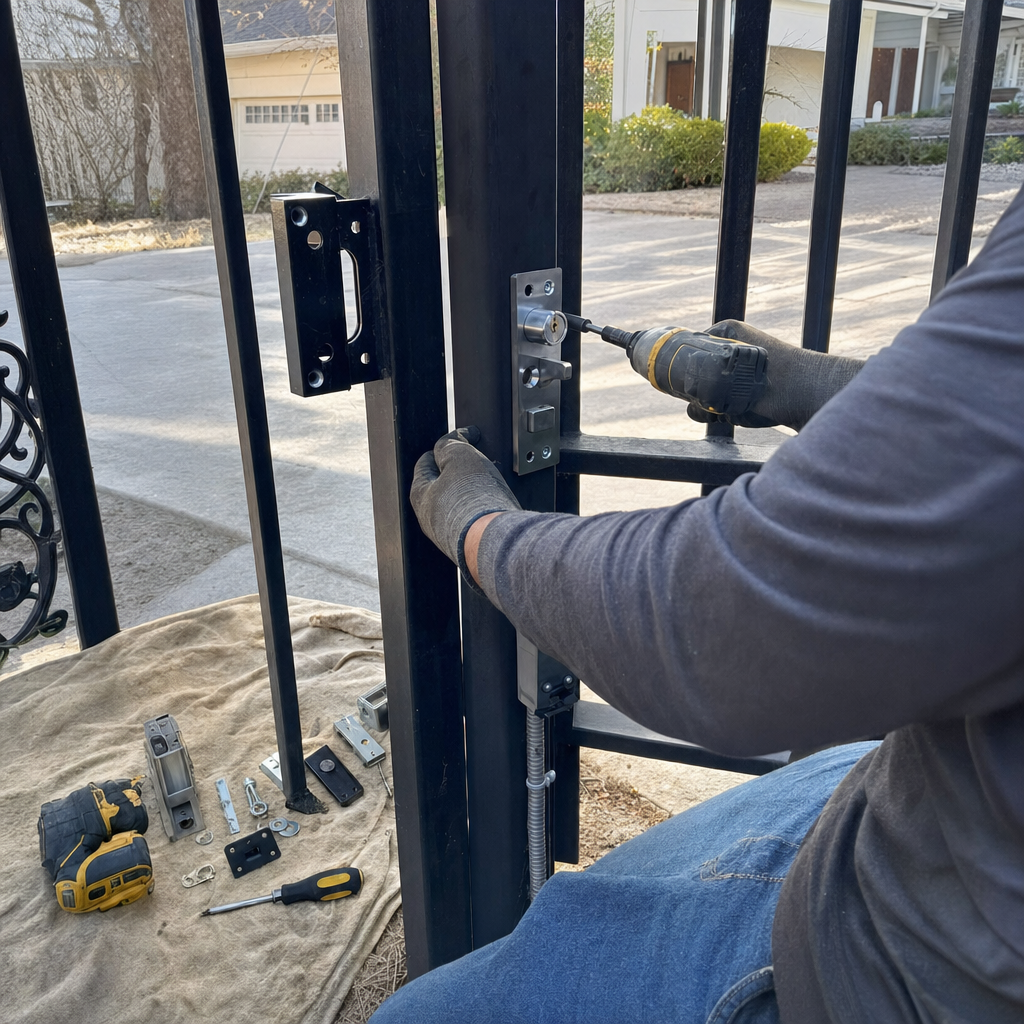
Last updated July 15, 2026
Gate Repair Permits, Codes & Inspections in TX: What You Need to Know
The permit question we get most often isn’t “do I need one” — it’s “do I really need one,” asked after a homeowner has already gotten an estimate from a contractor who told them permits weren’t necessary. Sometimes that contractor is right. Sometimes they just don’t want the inspection delay or the paperwork. In the Dallas metro, the rules vary so much between jurisdictions that a job requiring zero permits in unincorporated Dallas County might require a full building permit in Frisco — same gate, same motor, completely different rules. This guide maps out exactly where the lines fall, what the inspectors actually look for, and how to protect yourself if you skip the steps you shouldn’t.
Quick Answer
In Texas, gate repair permits are governed at the city or county level — not the state — so requirements differ significantly between Dallas proper, its suburbs, and unincorporated areas. As a general rule, like-for-like part replacements (a motor swap, a new control board) rarely require a permit, but structural changes, new post work, or a new gate repair installation almost always do. Skipping a required permit can void homeowner’s insurance claims and create serious complications when you sell the property.
Table of Contents
- Texas Permit Basics: Why There’s No Single Statewide Answer
- Dallas City Code: The Line Between Repair and Alteration
- Frisco, Plano, McKinney & Irving: Where the Rules Diverge
- The HOA Overlay: The Second Approval Layer Most Homeowners Miss
- What a Gate Permit Inspection Actually Checks
- What Happens When Unpermitted Gate Work Is Discovered
- How to Protect Yourself Contractually
- Common Mistakes to Avoid
- When to Call a Professional
- Frequently Asked Questions
- The Bottom Line
Texas Permit Basics: Why There’s No Single Statewide Answer
Texas does not have a statewide building code that uniformly governs gate installations. The state formally adopted the International Building Code (IBC) and International Residential Code (IRC) as its base framework, but individual municipalities have the authority to amend, supplement, or replace those codes with local ordinances. What this means practically: two properties sitting five miles apart in the Dallas metro can operate under entirely different permit rules.
Here’s the structure you need to understand:
- Incorporated cities (Dallas, Frisco, Plano, McKinney, Irving) each adopt and enforce their own local building codes.
- Unincorporated Dallas County areas fall under county jurisdiction, which is typically less restrictive — many routine gate repairs and even some installations don’t require permits.
- Extraterritorial Jurisdiction (ETJ) zones surrounding growing suburbs like McKinney and Frisco operate under those cities’ codes even though properties may not technically be inside city limits.
- HOA covenants function as a private regulatory layer that sits entirely outside the city permit system — you can pull the right city permit and still be in violation of your HOA restrictions.
The key takeaway: always verify with the specific jurisdiction where your property sits. Don’t rely on what your neighbor did, and don’t rely on a contractor’s blanket assurance. In our 14 years working gates across the Dallas area, we’ve seen permit oversights surface years later — almost always at the worst possible time, such as during a property sale.
Dallas City Code: The Line Between Repair and Alteration
Dallas proper uses the International Building Code with local amendments, administered through the City of Dallas Development Services Department. The threshold language that matters most for gate work is the distinction between “ordinary repair” and “alteration.”
Dallas’s code defines ordinary repair as work that restores a structure to its original condition without changing the structural components, materials, or design. Alteration means any work that changes or modifies beyond restoration. That single distinction is where most permit confusion originates.
Typically does NOT require a Dallas building permit:
- Replacing a failed gate motor with the same or equivalent model (like-for-like)
- Swapping a control board, replacing sensors, or reprogramming a LiftMaster or FAAC system
- Replacing gate hardware — hinges, rollers, wheels — on an existing gate
- Repairing damaged gate panels without altering the gate’s overall dimensions or structure
Typically DOES require a Dallas building permit:
- Installing a new gate where none existed before
- Replacing an existing gate with one of significantly different size, weight, or material
- Setting new posts in concrete or relocating existing posts
- Adding new electrical service to power an automatic opener
- Structural welding that alters the gate frame geometry
If your project falls anywhere near the “alteration” threshold, the safer and more defensible path is always to pull the permit. The filing fee in Dallas for a residential gate permit is a fraction of what unpermitted work complications cost at resale.
Frisco, Plano, McKinney & Irving: Where the Rules Diverge
The Dallas suburbs each administer their own codes, and the differences are real enough to change your project plan.
Frisco has been one of the most actively growing cities in the country, and its building department reflects that growth with a robust permit review process. Frisco requires permits for gate installations that include any electrical component or any work involving footings and posts. Even upgrading a manual gate to an automatic system — attaching a Ghost Controls or Mighty Mule opener to an existing gate — can trigger a permit requirement because of the electrical element.
Plano generally follows the IBC with amendments and requires permits for new gate installations and any structural modifications. Like-for-like motor replacements on existing systems are typically exempt, but Plano’s inspectors have been known to scrutinize driveway gate setbacks carefully — the distance from the gate to the public right-of-way matters for compliance.
McKinney is growing rapidly and its permit office has become more active in recent years. McKinney requires permits for new automatic gate installations and for work involving electrical connections. One area where McKinney diverges: ETJ properties outside city limits but within McKinney’s extraterritorial jurisdiction are still subject to city permit requirements — a detail many rural-adjacent property owners miss.
Irving follows a straightforward IBC framework but has specific provisions for commercial properties and apartment complexes that are stricter than residential. DoorKing and Elite access control installations at commercial gate entries in Irving almost always require both a building permit and an electrical permit pulled separately.
Bottom line: call the specific city’s building department before any project that involves new electrical, new posts, or a new gate. Five minutes on the phone saves months of headaches.
The HOA Overlay: The Second Approval Layer Most Homeowners Miss
This is the area where we see the most expensive surprises in the Dallas metro. HOA deed restrictions are a private contractual layer that operates entirely independently of city permit requirements. You can have every city permit approved and still be in material violation of your HOA’s covenants.
In master-planned communities across Dallas — communities like Stonebridge Ranch in McKinney, Starwood in Frisco, or the Lake Highlands estates neighborhoods in Dallas — the HOA’s Architectural Review Committee (ARC) has approval authority over any visible exterior change. Gate installations, replacements, or modifications that change the appearance of a gate (color, material, height, style) almost universally require ARC pre-approval.
What the HOA review typically covers:
- Material and finish: Many HOAs in Dallas-area communities restrict gate material to specific options — wrought iron or powder-coated steel, not chain-link or wood — and require finish colors to match or complement the home’s exterior.
- Height: Most residential HOAs in the area cap gate heights at 6 feet, with exceptions sometimes available for estate-sized lots.
- Setback from street: The gate must typically sit far enough back from the curb or sidewalk to allow a vehicle to queue without blocking traffic — a safety and aesthetic requirement the ARC enforces.
- Style consistency: In planned communities with a defined architectural theme, gates must be consistent with that theme.
The HOA review process is separate from the city permit process, runs on its own timeline (typically 15–30 days), and requires its own application with drawings or photos. We always recommend completing HOA pre-approval before ordering fabricated gate components, because HOA rejections can mean custom-fabricated parts that can’t be returned.
What a Gate Permit Inspection Actually Checks
If your project requires a permit, an inspector will visit the site — typically after installation is complete — to verify that the work matches the approved permit drawings and meets code. Understanding what they’re actually checking helps you avoid the three most common inspection failures we’ve seen on gate projects.
The three most common gate inspection failures:
- Entrapment zone non-compliance. UL 325 — the safety standard for automatic door and gate operators — requires that certain entrapment protection zones be free from obstruction and properly equipped with sensing devices. Inspectors verify that the gate operator has functioning entrapment protection: photo eye sensors, contact-sensitive edges, or both, positioned at the correct heights. A LiftMaster or FAAC commercial operator without properly placed and tested entrapment protection is the single most common reason gate installations fail inspection.
- Post footing depth and diameter. When new posts are set, inspectors check that the concrete footings meet the minimum depth specified in the permit drawings — typically 24–36 inches in the Dallas area depending on post height and gate weight. Undersized footings that might look fine visually are the most common structural failure point, and inspectors measure them.
- Electrical rough-in and bonding. For motorized gates connected to a 120V or 240V circuit, inspectors verify that the wiring was done to code — proper conduit, correct breaker sizing, and ground bonding. Work done by a gate installer who lacks an electrical license but ran the wiring anyway is a red flag inspectors are specifically trained to identify.
How to pass the first time:
- Have the permit drawings on-site and match the installation to them exactly.
- Test all entrapment protection devices before the inspection and document that they were tested.
- Use a licensed electrician for any line-voltage wiring, even if the gate installer is handling everything else.
- Photograph footing depths before concrete is poured — this creates a paper trail if there’s any dispute.
What Happens When Unpermitted Gate Work Is Discovered
The consequences of skipping a required permit aren’t hypothetical — they’re predictable, and they tend to surface at the worst possible moments.
Property sale complications: When you sell a property in Texas, you’re required to disclose known material defects and unpermitted modifications. A buyer’s home inspector or the buyer’s lender may flag an automatic gate installation that has no permit history. The outcome is typically one of three things: the seller pulls a retroactive permit (which often requires an inspector to see the work, which may require opening walls or exposing buried footings), the seller offers a price concession, or the deal falls through. In the competitive Dallas real estate market, unpermitted gate work has killed more than a few deals.
Homeowner’s insurance claim denials: If a structural element of your gate — a post, a frame, a footing — fails and causes property damage or personal injury, and that element was installed without a required permit, your homeowner’s insurance carrier has grounds to deny the claim. The unpermitted work voids the coverage assumption that the installation was code-compliant.
Stop-work orders and fines: If a city inspector discovers unpermitted work in progress — often reported by a neighbor — a stop-work order freezes the project immediately. In Dallas, the permit retroactivity process includes fees that can be multiples of the original permit cost.
HOA enforcement: HOAs in the Dallas metro can require removal of non-approved structures at the homeowner’s expense. We’ve seen brand-new gate installations ordered removed because the homeowner skipped the ARC approval process.
How to Protect Yourself Contractually
Whether you’re hiring a gate specialist or a general contractor for gate work, knowing how to hire the right contractor and getting the written agreement right is your primary protection. Here’s what the contract should address explicitly before any work begins.
The clause that matters most: Include specific language that designates permit responsibility. It should read something like: “Contractor is responsible for determining permit requirements applicable to the described scope of work, obtaining all required permits prior to commencement, and scheduling all required inspections. Contractor assumes all liability for fines, stop-work orders, or costs arising from unpermitted work performed under this agreement.” That clause shifts both the responsibility and the financial risk to the party doing the work.
Additional contractual protections:
- Scope of work specificity: The contract should describe exactly what is being done — “like-for-like motor replacement of existing Viking operator” is more protective than “gate repair.” Specificity determines whether the permit question was correctly answered.
- Permit documentation: Ask for a copy of any permit pulled and the final inspection sign-off. Don’t accept verbal assurances. Keep these documents with your property records.
- HOA approval confirmation: If you’re in an HOA community, the contract should confirm that HOA pre-approval has been obtained or that the homeowner takes responsibility for it.
- Lien waiver: Request a lien waiver upon final payment to ensure no subcontractors or suppliers can place a lien against your property for unpaid bills.
- UL 325 compliance statement: For any automatic gate installation, ask the contractor to confirm in writing that the installation meets UL 325 entrapment protection standards.
A contractor who balks at any of these provisions — especially the permit responsibility clause — is worth reconsidering. Reputable gate specialists will have no problem committing these items to writing because they’re already doing them.
Common Mistakes to Avoid
- Assuming your neighbor’s permit experience applies to your project. Two homes in the same subdivision can have meaningfully different permit requirements if the scope of work differs. Never use what someone else did on their gate as your guide — call the building department directly with your specific scope.
- Skipping HOA pre-approval because the city permit was approved. City permits and HOA covenants are completely separate systems. Approval from one doesn’t touch the other. In master-planned communities across the Dallas metro, HOA violations are enforced aggressively and retroactive removal orders are real.
- Letting the gate installer run line-voltage electrical work without a licensed electrician. In Dallas and most of its suburbs, 120V and 240V wiring requires a licensed electrician. A gate technician connecting a motor to a new circuit without an electrical license creates an unlicensed work problem that the permit inspection will surface.
- Not photographing footing depths before the concrete pour. If an inspector raises a question about post footing compliance after the fact, you have no visual record. Photograph footings with a measuring tape in the frame before pouring — it’s a five-minute step that can prevent significant cost.
- Accepting a verbal assurance that permits aren’t required. Get it in writing. If a contractor tells you no permit is needed, have them state that in the contract with language indicating they’ve verified the requirement with the applicable jurisdiction. Verbal assurances disappear when complications arise.
- Upgrading from manual to automatic without checking electrical permit requirements. Adding any automatic gate opener — even a residential Ghost Controls or Mighty Mule unit — may require an electrical permit if new wiring is run to the gate. This step is frequently overlooked on what feels like a simple residential upgrade.
- Not obtaining a final inspection sign-off and keeping the paperwork. Pulling a permit and completing the work isn’t the finish line — the final inspection sign-off is the document that closes the permit record. Without it, the permit remains open and the work is technically still flagged. Keep the signed inspection card or the city’s digital close-out confirmation with your property documents.
When to Call a Professional
Some gate situations are clearly DIY-friendly: resetting a keypad, lubricating a roller track, replacing a remote battery. But the following scenarios call for a specialist who knows the permit landscape as well as the mechanical work; see our seasonal gate maintenance guide for ongoing care tips:
- Any project involving new concrete footings or post relocation
- Converting a manual gate to automatic operation
- Replacing a failed operator with a different brand or significantly different model
- Any structural welding on the gate frame
- Adding or modifying access control — keypads, card readers, telephone entry systems like DoorKing
- Commercial gate projects in Irving, Dallas, or any Dallas suburb where dual permits (building + electrical) are likely required
- Any project where your HOA’s ARC has jurisdiction over exterior changes
As a dedicated gate specialist operating in the Dallas area for 14 years, Dependable Gate Repair Services Dallas handles the permit question as part of every project assessment — not as an afterthought. Ronald Clark personally evaluates the scope, identifies what the applicable jurisdiction requires, and ensures the work is done in a way that survives inspection and protects the property owner. Call (817) 369-3225 for a free on-site estimate — and bring the permit question with you. We’ll give you a straight answer.
Frequently Asked Questions
Do I need a permit to replace a gate motor in Dallas?
In most cases, no — if you’re doing a like-for-like motor replacement on an existing automatic gate without modifying the gate structure, electrical service, or post work, Dallas treats this as ordinary repair and no permit is required. The exception is if the replacement requires running new electrical wiring to the operator location, which may trigger an electrical permit separately. When in doubt, a quick call to the Dallas Development Services Department at the project address will give you a definitive answer. For a free evaluation of your specific situation, call us at (817) 369-3225.
Does Frisco require a permit for adding an automatic gate opener to an existing manual gate?
Yes, Frisco typically does require a permit when an automatic opener is added to an existing manual gate, primarily because the electrical component — even a low-voltage wiring connection — triggers the city’s electrical permit requirement. The gate structure itself may also need review if the opener adds significant mechanical load to the existing posts. This is one of the most common permit surprises we see in Frisco and the surrounding ETJ areas. Call (817) 369-3225 if you’re planning this upgrade — we can assess the scope before you commit to a product or a timeline.
Can my HOA deny a gate installation even if I have a city permit?
Yes, absolutely. HOA deed restrictions and city building permits operate as entirely separate approval systems, and approval from one has no bearing on the other. In master-planned communities throughout the Dallas metro — including many in McKinney, Frisco, and North Dallas — the Architectural Review Committee has contractual authority to require gate removal at the homeowner’s expense if pre-approval was not obtained, regardless of whether the city permit is in perfect order. Always complete HOA pre-approval before ordering materials or scheduling installation.
What is UL 325, and why does it matter for gate inspections?
UL 325 is the safety standard governing automatic door and gate operators in the United States, and it specifically addresses entrapment hazards — the risk of a person or vehicle being pinned by a moving gate. Inspectors in Dallas and surrounding municipalities check that automatic gate installations include functioning entrapment protection (photo eyes, contact-sensitive edges, or both) at the correct heights and properly configured. Failure to meet UL 325 entrapment requirements is the single most common reason residential and commercial gate installations fail their first inspection. Any reputable gate specialist — and any quality operator from LiftMaster, FAAC, BFT, Viking, or Linear — will build UL 325 compliance into the installation by design.
What happens if I sell my Dallas home and there’s an unpermitted gate on the property?
Unpermitted gate work discovered during a property sale in Texas can result in one of three outcomes: a retroactive permit application (which may require an inspector to verify or expose the work), a price concession to the buyer, or a collapsed transaction if the buyer’s lender requires code compliance. Texas sellers are required to disclose known material defects and unpermitted modifications, so non-disclosure carries its own legal risk. The cost of pulling a retroactive permit is almost always higher than the original permit fee would have been. If you’re buying or selling a property with an automatic gate, a pre-listing gate inspection from a specialist can identify issues before they surface at the worst moment.
How do I know if my gate repair contractor is handling permits correctly?
Ask directly and get the answer in writing before signing anything. A contractor who has assessed the permit requirements should be able to name the specific jurisdiction, state whether a permit is required for your scope, and explain why. If they’re pulling a permit, you should receive a copy before work begins — permit numbers are public record and verifiable. Include a clause in your written agreement that explicitly places permit responsibility on the contractor and holds them liable for costs arising from unpermitted work. A gate specialist with 14 years of experience working in the Dallas metro shouldn’t hesitate to put permit responsibility in writing — if they do hesitate, that’s meaningful information.
The Bottom Line
Texas leaves gate permit requirements to local jurisdictions, which means the rules in Dallas proper, Frisco, McKinney, Plano, and unincorporated Dallas County can differ in ways that materially affect your project. The general framework is consistent: like-for-like repairs typically don’t require permits, while new installations, structural changes, and new electrical work usually do. HOA approval requirements exist entirely outside the city permit system and carry their own enforcement teeth. Unpermitted work surfaces at property sales and insurance claims — both at the worst possible moment. The protective moves are simple: verify with the jurisdiction, get HOA pre-approval in writing, include a permit responsibility clause in your contractor agreement, and always obtain the final inspection sign-off. Working with a Gate Repair in Dallas specialist who knows the local code landscape — and who handles the permit question as part of the job, not as an afterthought — is the most reliable way to avoid these problems entirely.
If you have a gate project in the Dallas area and want to understand exactly what permits apply, Ronald Clark at Dependable Gate Repair Services Dallas offers free on-site estimates and will give you a direct, jurisdiction-specific answer on permit requirements before any work begins. Whether your system runs LiftMaster, FAAC, BFT, Linear, Viking, Ghost Controls, DoorKing, Elite, or Mighty Mule, we’ve worked on it — and we know how the local permit process applies to it. For Gate Installation in Dallas or any Gate Motor & Opener in Dallas project, call (817) 369-3225 today. Estimates are free, and the permit question gets answered on the first call.
Written by Ronald Clark, Owner & Lead Technician at Dependable Gate Repair Services Dallas, serving Dallas since 2012. For more guides & resources, visit our blog.