Last updated July 15, 2026
Seasonal Gate Repair Care for Dallas: Year-Round Homeowner’s Guide
Most gate failures in Dallas don’t happen without warning — they happen because the warning signs went unread through the wrong season. Dallas’s climate doesn’t distribute wear evenly across twelve months. Two seasons do roughly 80% of the damage to your gate system: summer heat that cooks control boards and strains motors, and the freeze-thaw cycles of a North Texas winter that crack hydraulic lines and fog sensor lenses. The remaining two seasons — fall and spring — are your windows to act before and after the damage accumulates. If you understand that cycle, you’ll spend less money on emergency repairs and more time actually using your gate — or let our Gate Repair services handle the seasonal stress for you.
Quick Answer
Seasonal gate maintenance in Dallas should be scheduled twice a year at minimum: once in late September (after summer stress has accumulated but before winter freezes arrive) and once in March (after the last hard freeze but before spring rains saturate clay soil and shift gate posts). Dallas’s extreme heat, infrequent but severe ice events, and expansive clay soils create failure patterns that don’t match generic maintenance calendars written for moderate climates. Aligning your upkeep schedule to these local conditions — as detailed in The Complete Guide to Gate Repair in Dallas — is the single most effective thing a Dallas homeowner can do to extend gate system life.
Table of Contents
- Summer (June–August): Heat Is Your Gate’s Biggest Enemy
- Fall (September–October): The Best Maintenance Window in Dallas
- Winter (November–February): Ice Events, Hydraulics, and Sensor Prep
- Spring (March–May): Hail Inspection and Post-Movement Assessment
- Month-by-Month Quick-Action Calendar
- Common Mistakes to Avoid
- When to Call a Professional
- Frequently Asked Questions
Summer (June–August): Heat Is Your Gate’s Biggest Enemy
Dallas summers are not just hot — they’re persistently, relentlessly hot in ways that matter specifically to gate electronics. When ambient temperatures hit 104°F in July and August (a routine occurrence across neighborhoods from Uptown to Far East Dallas), the temperature inside a sealed gate operator enclosure can reach 130°F or higher. At that range, circuit boards on LiftMaster, Linear, and FAAC operators begin experiencing thermal drift — the kind that causes intermittent, maddening failures that disappear by morning and return every afternoon.
What that looks like in practice: your gate opens fine at 7 a.m. but refuses to respond at 3 p.m. The board hasn’t failed yet, but it will. We’ve seen this pattern repeatedly on BFT and Viking systems where homeowners waited through three or four “it fixed itself” cycles before the board failed completely — always on a 105-degree Friday afternoon.
The other summer variable is motor duty cycle. Most residential gate operators are rated for a specific number of cycles per hour before needing a rest period. During heat waves, that effective rating drops. If your gate opens and closes 15–20 times a day — common in households with multiple drivers — you’re running the motor harder in the worst possible conditions. Ghost Controls and Mighty Mule systems designed for lighter residential use are particularly vulnerable here.
Signs of Heat-Related Failure to Watch For
- Afternoon-only sluggishness: Gate moves slower or stops mid-travel only during the hottest part of the day — classic thermal stress on the motor windings.
- Error codes that reset overnight: On LiftMaster and DoorKing systems, stored error codes that clear by morning point to thermal shutdown, not a software issue.
- Capacitor swelling: If you can safely view the control board, look for capacitors that appear domed on top rather than flat — a direct sign of heat damage.
- Battery backup failure: Sealed lead-acid batteries lose capacity rapidly above 90°F. A battery that tested fine in April may be functionally dead by August.
- Sensor misalignment: Ground expansion in Dallas’s clay-heavy soil shifts post alignment through summer, throwing photoelectric sensors out of calibration.
What to do in summer: Shade the operator enclosure where possible (a simple louvered cover helps significantly). Reduce unnecessary gate cycles during peak heat hours. Check battery condition monthly. If your system is showing afternoon errors, don’t wait — the board is telling you something.
Fall (September–October): The Best Maintenance Window in Dallas
If you only do one maintenance session per year on your Dallas gate, do it in late September — a key checkpoint from our Gate Repair Maintenance Checklist for Dallas Homeowners. This is the single most important piece of advice in this entire guide, and here’s the logic: by late September, your gate system has just survived its hardest stretch of the year. Every component — motor, board, battery, hardware — has been stressed for three months. October gives you mild temperatures, low humidity, and a narrow window before Dallas’s winter ice events arrive. It’s the natural reset point for the system.
This is the time to do the work that actually prevents failures, not just respond to them. In our experience working across Dallas’s gate systems since 2011, the majority of winter failures we respond to in January and February were preventable with a proper fall service in October.
Fall Maintenance Checklist (In Order of Priority)
- Battery backup replacement: If your battery is more than 18 months old and survived a Dallas summer, replace it now. Don’t test it — replace it. A battery that appears functional in October can fail in a January ice event when you need it most.
- Full lubrication cycle: Apply a silicone-based lubricant to all roller bearings, hinges, and chain drives. Avoid WD-40, which attracts dust and dries out quickly. For swing gate pivot points, a lithium grease holds up better through temperature swings.
- Alignment and travel limit check: Summer ground movement in clay soil shifts gate posts. Re-check that open and close limits are set correctly and that the gate is plumb. An off-plumb gate strains the motor every single cycle.
- Sensor lens cleaning: Clean all photoelectric and loop detector sensors. Summer dust accumulation and spider webs (a real problem in Dallas’s drier months) cause nuisance reversals and false triggers.
- Hardware torque check: Tighten all bolts on mounting brackets, operator arms, and hinge hardware. Thermal expansion and contraction through summer loosens fasteners more than most homeowners realize.
- Control board visual inspection: Look for burn marks, corrosion, or swollen capacitors. This is your last clean look before winter.
- Entrapment protection test: Verify auto-reverse sensitivity is correctly calibrated. This is a safety test, not just a maintenance item.
For HOA managers overseeing community gates in areas like Lake Highlands or Prestonwood, fall is also the time to schedule a professional inspection before the board approves the winter budget — it’s easier to fund repairs in October than to justify emergency calls in February.
Winter (November–February): Ice Events, Hydraulics, and Sensor Prep
Dallas winters are mild right up until they’re not. The city averages fewer than five significant freeze events per year, but those events are severe precisely because the infrastructure — including gate systems — isn’t maintained for sustained freezing the way systems in Chicago or Denver are. The freeze-thaw cycle is the specific villain here: temperatures drop below 28°F for 12–18 hours, then climb above 40°F by afternoon. That repeated contraction and expansion is more damaging to gate hardware than a steady cold would be.
Hydraulic gate operators — common on heavier commercial-grade swing gates — are particularly vulnerable. Hydraulic fluid thickens significantly below 30°F, causing operators to move sluggishly or stall entirely. FAAC and BFT hydraulic systems we service regularly show this pattern in Dallas’s January and February cold snaps. If your FAAC system hasn’t had its hydraulic fluid checked in two years, a Dallas winter is the wrong time to find out it’s degraded.
Winter Prep Steps Most Dallas Homeowners Skip
- Sensor lens insulation: Photoelectric sensors can develop internal condensation during freeze-thaw cycles. A simple foam weatherstripping gasket around the lens mount prevents moisture intrusion that fogs the optic permanently.
- Hydraulic fluid check: For FAAC and BFT systems, verify fluid type is rated for temperatures down to at least 10°F. Dallas occasionally hits single digits during major winter events — the 2021 freeze being the most recent example.
- Battery heater wraps: If your operator is in an exposed location in a North Dallas or Plano-area home without an enclosure cover, a battery thermal wrap ($15–$25 at any hardware store) can be the difference between a working gate and a locked gate during an ice event.
- Manual release test: Test your manual disconnect before winter. If power goes out during an ice event and you’ve never used the manual release, that’s a bad time to discover the key is stuck or the release mechanism has seized.
- Gate frame inspection for stress cracks: Welded steel gates develop micro-cracks at stress points. Freeze-thaw cycles widen those cracks. Inspect welds at hinge plates and operator mounting points before temperatures drop.
During an actual ice event: avoid forcing a frozen gate manually. If the gate is frozen shut, running the motor against ice-locked hardware destroys the operator arm and, in some cases, the motor. Wait for temperatures to rise above 35°F or apply a low-concentration deicer to moving parts before attempting operation.
Spring (March–May): Hail Inspection and Post-Movement Assessment
Spring in Dallas arrives with two specific threats to gate systems that most maintenance guides don’t address: hail and clay soil movement. Both are highly localized to North Texas conditions and both cause damage that looks unrelated to a gate system until it isn’t.
Dallas sits in one of the most hail-active corridors in the United States. A spring hailstorm — the type that routinely hits neighborhoods from Oak Cliff to Garland between March and May — can dent operator enclosure lids, shatter sensor lens covers, crack control board housings, and damage keypad faceplates. None of this damage is dramatic or immediately obvious, but a cracked control enclosure left through summer will allow moisture and heat to destroy the board inside within one season.
Hail Damage Inspection Checklist for Gate Hardware
- Check the operator enclosure lid for dents that have compromised the gasket seal. Press the lid — if it flexes inward and doesn’t spring back cleanly, the seal is broken.
- Inspect all sensor housings for cracks. Photoelectric sensors are particularly vulnerable; even a hairline crack in the lens cover admits enough moisture to fog the optic.
- Check keypad and intercom faceplates for impact damage. A cracked keypad faceplate on a DoorKing or Elite access system is a water intrusion point.
- Inspect the gate frame itself for any dents at the top rail — hail damage here isn’t structural, but it tells you the storm was strong enough to potentially affect other components.
- Check all wiring conduit entry points into the operator. Hail can dislodge conduit clamps and create gaps where water enters the enclosure.
The second spring issue is post movement from heavy rains on Dallas’s clay soil. The expansive clay that underlies most of Dallas and its surrounding areas swells significantly with moisture absorption — spring rains of 3–5 inches over a week (common in April) can shift a gate post by a quarter inch or more. That’s enough to throw off auto-reverse calibration, bind the gate frame against the catch plate, or misalign the operator arm. After any significant spring rain event, walk the gate through a full manual cycle while watching for binding or scraping — those are your indicators that post movement has occurred.
If you’re seeing significant post movement, that’s a foundation repair conversation, not just a gate adjustment. We routinely see this in older installations in areas like East Dallas and the M Streets where original post concrete was poured shallow.
Month-by-Month Quick-Action Calendar
Each check below takes under 10 minutes. None of them require tools. These are observation tasks designed for homeowners — not maintenance crews.
- January: Test manual release mechanism. Verify battery indicator light. Check sensor lens for condensation damage after any freeze event.
- February: Listen for hydraulic sluggishness in cold mornings (FAAC/BFT owners). Check gate frame welds for new cracks after freeze-thaw events.
- March: Full post-winter reset: check alignment after ground thaw, clean all sensor lenses, test auto-reverse. Begin hail inspection after any significant storm.
- April: After spring rains, walk the gate through a full cycle watching for binding. Check post plumb with a level if you see any dragging.
- May: Check enclosure seals before summer humidity peaks. Test battery backup with a manual power disconnect.
- June: Reduce discretionary gate cycles during heat waves. Check for afternoon error codes — log them, don’t ignore them.
- July: Inspect battery — if it’s over 18 months old, plan to replace it in September. Check for capacitor swelling on control board if you’re comfortable doing so safely.
- August: Note any performance changes compared to June. A gate that’s slowing down in August after running fine in June has a developing motor or thermal issue.
- September: Full fall service window — see the Fall Maintenance Checklist above. This is the most important month on this calendar.
- October: Replace battery if not done in September. Final alignment and limit check before temperatures begin dropping.
- November: Test manual release. Wrap battery if in exposed location. Check hydraulic fluid if applicable.
- December: Verify all sensor lenses are clean and dry before winter freeze season. Confirm deicer is on hand.
Common Mistakes to Avoid
- Using WD-40 as a gate lubricant: WD-40 is a water displacer and light penetrating oil, not a long-term lubricant. In Dallas’s summer heat, it evaporates quickly, leaving metal-on-metal contact. Use silicone spray for slides and tracks, lithium grease for pivot points and hinge barrels.
- Ignoring afternoon-only gate failures in summer: Dallas homeowners frequently dismiss a gate that “fixes itself overnight” as a glitch. It’s not — it’s a gate operator running in thermal stress. Waiting through three or four of these events usually ends with a complete board failure on the hottest day of the year.
- Forcing a frozen gate during an ice event: Running a LiftMaster, Viking, or Elite operator against an ice-locked gate arm destroys the mechanical linkage and can strip the motor. The repair cost is always higher than waiting 90 minutes for temperatures to rise.
- Skipping post-movement checks after spring rains: Dallas’s clay soil is expansive. A gate that was perfectly aligned in February can be binding against its strike plate by April after 6 inches of spring rain. Binding gates stress the operator arm every cycle — a quiet failure that accelerates motor wear invisibly.
- Replacing a battery in spring instead of fall: A new battery installed in April will survive its first summer — but just barely. A battery installed in September enters winter fully conditioned and exits the following summer with useful life remaining. Timing matters more than most homeowners realize.
- Assuming a gate system is “fine” because it’s working: Gate operators give clear warning signs before failure — slowing travel times, error codes, morning-only operation, unusual motor sounds. In 14 years of gate work in Dallas, we’ve rarely seen a complete gate failure that didn’t have a three-to-six week warning period that went unheeded.
- Leaving hail damage uninspected: A dented enclosure lid or cracked sensor housing after a spring hailstorm looks cosmetic. By August, the moisture and heat that entered through that crack will have destroyed the board inside. File a homeowner’s insurance check, replace the housing — don’t table it until something stops working.
When to Call a Professional
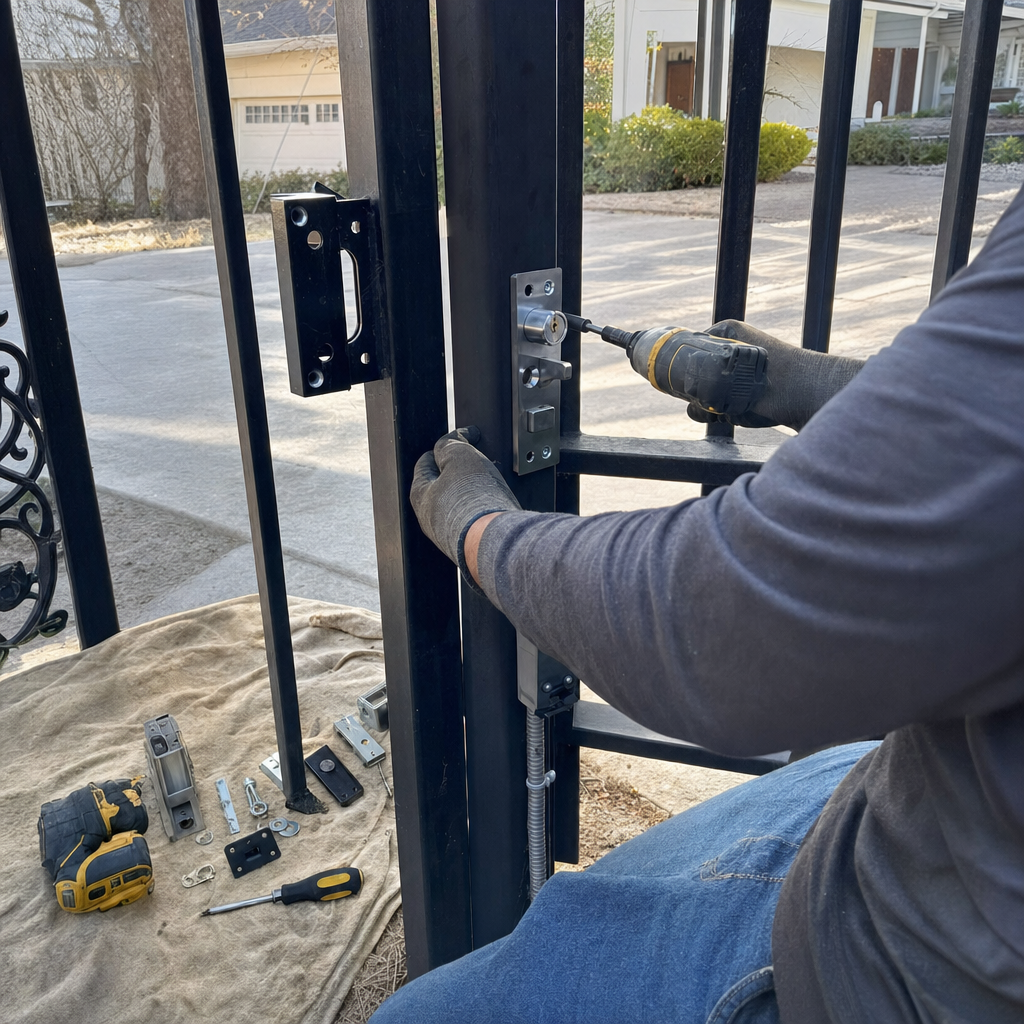
Some gate issues are genuinely DIY-friendly: cleaning sensor lenses, lubricating hardware, testing battery backup, and running a manual release. These tasks are designed to be owner-serviceable and the calendar above gives you the timing for all of them.
Call a gate specialist when you see any of the following:
- Error codes that return after clearing — especially thermal or motor-load codes on LiftMaster, FAAC, or BFT systems
- A gate that travels slower than it did six months ago — motor wear, not a setting
- Any visible burn marks, corrosion, or swollen capacitors on the control board
- Post movement significant enough that the gate is dragging or failing to latch
- Cracked welds at hinge plates or operator mounting arms — a structural failure waiting to happen
- Any failure during or immediately after a Dallas ice event, where forced operation may have caused mechanical damage
These are not tasks where a second opinion helps — they’re tasks where wrong-direction troubleshooting causes additional damage. Gate Repair in Dallas from a dedicated specialist means diagnosis is faster and parts are usually on hand. Dependable Gate Repair Services Dallas offers free estimates — call Ronald Clark directly at (817) 369-3225 to schedule a same-day assessment.
Frequently Asked Questions
How often should I service my gate in Dallas?
At minimum, twice per year — once in late September and once in March. Dallas’s climate creates two concentrated stress periods (summer heat and winter freeze-thaw cycles) with two shorter transition windows. A gate system serviced only once per year should be serviced in late September, when it has just survived summer and needs to be prepared for winter. Annual professional inspections should complement your monthly quick-checks from the calendar above.
Why does my gate work fine in the morning but fail in the afternoon during summer?
This is thermal stress on the gate operator circuit board. When Dallas ambient temperatures exceed 100°F, enclosed operator boards can reach 125–130°F — enough to cause thermal shutdown or intermittent failure that resolves as temperatures drop overnight. The gate is warning you that the board or motor is under thermal stress. Don’t ignore this pattern; it typically precedes a complete failure within the same season. Call (817) 369-3225 for a free diagnostic estimate before it becomes an emergency.
What should I do with my gate during a Dallas ice event?
Do not force the gate if it’s frozen shut or moving stiffly. Running a LiftMaster, Viking, or Elite operator against ice-bound hardware damages the mechanical arm and, in severe cases, the motor. Wait for temperatures to climb above 35°F, or apply a light deicer (not road salt) to hinges and the gate frame before attempting operation. Test your manual release before winter arrives — not during an ice event. If the gate was forced during an ice event and is now making grinding or clicking sounds, the arm or motor linkage likely needs inspection.
Does Dallas’s clay soil actually affect gate posts?
Yes, more than most homeowners expect. Dallas sits on expansive clay that swells with moisture and contracts with drought. A gate post anchored in spring-saturated soil can shift a quarter inch or more compared to its late-summer position. This seasonal movement is enough to misalign auto-reverse sensors, cause the gate frame to bind against the catch plate, and strain the operator arm on every cycle. If your gate starts dragging or failing to latch cleanly in April after heavy rains, check post plumb with a level before assuming the operator needs adjustment.
How long should a gate operator battery backup last in Dallas?
In a moderate climate, sealed lead-acid gate batteries typically last 3–4 years. In Dallas’s summer heat, expect 18–24 months of reliable performance. Batteries stored in enclosures that reach 130°F through July and August lose capacity far faster than the manufacturer’s rated lifespan assumes. Replace your battery every fall regardless of apparent condition if it is approaching 18 months old. A battery that fails in a January ice event when power is out is a significant security exposure — the replacement cost is always less than the consequence.
Can I handle seasonal gate maintenance myself, or do I need a professional every time?
The monthly quick-checks on the calendar — sensor cleaning, battery indicator checks, listening for binding, testing manual release — are designed for homeowners and require no special tools or gate knowledge. The fall and spring service items that involve torque checks, limit adjustments, control board inspection, and hydraulic fluid verification are best handled by a gate specialist, particularly if your system is a brand like FAAC, BFT, or DoorKing where board-level diagnostics require brand-specific tools. A professional annual inspection through a service like Dependable Gate Repair Services Dallas home typically catches issues at the component level before they become system failures.
The Bottom Line
Dallas gives you two seasons that damage gate systems — summer and winter — and two windows to fix what those seasons cause. Align your maintenance to that reality, not to a generic four-season calendar written for a milder climate. Late September is your most valuable maintenance date. March is your second most important. The monthly calendar above costs you less than two hours per year and will extend the life of your gate system by years; for ongoing help, see more guides & resources on our blog. When you see the warning signs described above — afternoon failures, slow travel, post movement, hail damage — act on them early. A gate that warns you in August is giving you a gift. Use it.
Ready to schedule your fall or spring gate service in Dallas? Ronald Clark personally handles diagnostic and maintenance calls across Dallas. Estimates are free, parts are stocked on the truck, and there’s no second visit for most repairs. Call Dependable Gate Repair Services Dallas at (817) 369-3225 to book a time that works for you.
For full service details, visit our Gate Motor & Opener in Dallas page or explore our Gate Installation in Dallas services if your system is past the point of repair.
Written by Ronald Clark, Owner & Lead Technician at Dependable Gate Repair Services Dallas, serving Dallas since 2012.